Business-to-business (B2B) sourcing is the modern e-commerce that allows companies to source material, negotiate terms, and complete transactions in the easiest possible way. It generally involves sourcing from the other business, so whether you’re a wholesaler, retailer, manufacturer, or startup, b2b makes the sourcing accessible meanwhile driving the profitability, enhancing efficiency, and securing the quality of suppliers needed for innovation in work processes.
Although b2b is taking full swing in its digital phase, where businesses are making faster and more transparent decisions while reducing risk exposure, in this guide, you’ll learn what B2B sourcing is, how it works, and why it’s essential for today’s business.
What is B2B Sourcing?
B2B sourcing refers to the process through which one business acquires raw materials, goods, or services from another business. Just like its B2C counterpart, businesses sell their products usually in bulk and other value-added services. However, on the B2B marketplace, the sellers are typically suppliers, manufacturers, brands, and wholesalers, while the customers are other businesses.
Depending on the B2B growth, the business ensures high quality product at an affordable price, which leverages the business growth. The global B2B e-commerce market is valued at $32.11 trillion as of 2025 and is expected to grow at a CAGR of 14.5% expected to reaching $36.16 trillion by 2026.
And majorly, these sales are associated with the heavy industries such as advanced manufacturing, energy, healthcare, and professional business service segment drive the majority of this B2B ecommerce sales.
Understand the Basic Difference Between B2B and B2C Sourcing
| Aspects | B2B Sourcing | B2C Sourcing |
| Primary Buyer | Business, manufacturer, or retailer. | Individual consumer |
| Purchasing Goal | Rational, strategic, and needs-based | Emotional desire based |
| Decision Making | Complex, multi-stage, and multiple stakeholders (e.g, ROI, impact on organization. | Simple, often impulsive, or personal decision by a single individual. |
| Pricing | Variable and highly negotiable | Fixed, non-negotiable, and transparent |
| Product Focus | Raw material, components, industrial supplies, softwarenand services. | Finished goods ready for immediate consumption |
| Relationship | Long-term relationships and consistent supply chain management | Less emphasis on long-term relationships. |
| Risk Management | Address issues like supply interruptions and compliance risks | Primarily focuses on customer experience |
| Negotation | More concern about negotiation with custom pricing and contracts | Generally straightforward pricing with less negotiation |
Key Components of B2B Sourcing
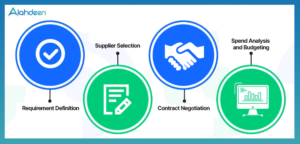
-
Requirement Definition
It is the crucial steps that can’t be missed. This involves defining what is needed by working closely with internal stakeholders. Plus, it can save you from identifying cost-saving opportunities and areas where supplier consolidation may be beneficial.
-
Supplier Selection
It is the backbone of the B2B sourcing. Find the supplier that meets the defined requirement. This involves identifying potential suppliers, evaluating their capabilities, and shortlisting those who align with organizational needs. After supplier identification, it’s time to check suppliers’ qualification typically involves reviewing their financial stability, operational capacity, quality certification, and more.
-
Contract Negotiation
What do you think about negotiation in terms of money? This negotiation involves discussion with the top-ranked suppliers to secure the best payment terms, along with the payment levels, service level agreements (SLAs), warranty details, and intellectual property rights.
-
Spend Analysis and Budgeting
Spend analysis involves procurement data to uncover cost-saving opportunities. By systematically collecting, cleaning, and categorizing all purchasing data, it enables the finance team to create highly accurate forecasts and strategically reallocate funds for growth.
Benefits of Effective B2B Sourcing
Every B2B marketplace is now switching, where 75% of purchases are made online. Well, there are various reasons why the B2B marketplace is expanding, mainly because this platform enables suppliers to build a 24/7 online presence. Plus, they also allow the businesses to capitalize on existing buyer demand and expand their network globally, without the much-needed b2b marketing investment.
Let’s look at what you can get:
- Thousands of suppliers in one place
- Rate comparison
- Verified wholesaler
- Fast communication
- Negotiable pricing
- Bulk order options
- Digital order tracking
Top B2B Sourcing Platform in Pakistan
Pakistan’s B2B sector is rapidly shifting; these platforms genuinely simplify procurement and supply chain management for businesses across the country, while providing inventory financing, last-mile delivery, and real-time analytics.
-
Alahdeen
Pakistan’s first commission-free model, primarily designed in a way to connect buyers with suppliers even in small towns. Alahdeen B2B Marketplace focuses on creating value-driven connections and offers digital solutions for small and medium enterprises across major cities like Karachi, Lahore, and Islamabad, ensuring a smooth and transparent customer experience.
-
Bazaar
Bazaar Technologies is Pakistan’s leading e-commerce and financial services technology company that connects households and businesses to an extensive range of products from groceries to supplies. Additionally, Bazaar also has fintech capabilities, offering digital ledger tools like Easy Khata helps merchants manage credit, payments, and accounting, positioning that handles procurement, fulfillment, and financial operating software for its extensive network.
-
Zarea
Zarae Limited is a public limited company that operates as a B2B e-commerce marketplace. This specialized platform is facilitating transactions for high-volume goods such as cement, steel, coal, fertilizer, and grains. Plus, this platform also provides real-time tracking, quality assurance from Pakistan’s verified suppliers while promising delivery in 72 hours.
-
ChaiCon
ChaiCon is described as a specialized Made in Pakistan B2B platform aimed at promoting entrepreneurship and investment within the country. Its core mission is to support domestic manufacturing by providing a unified storefront for diverse categories such as fashion, home goods, food products, and more.
-
BuyPass
BuyPass is the latest commerce platform that revolutionizes Pakistani purchasing by delivering seamless purchases from trusted merchants in Fashion, Electronics, Beauty, and Home Décor. Fast commerce delivery, often within 3 hours for same-city orders, is a competitive advantage.
BuyPass integrates content commerce through a new shopping channel, making the procurement process more engaging and fascinating for business buyers and retailers who need fast and verified inventory.
Conclusion
While summing up the blog, b2b sourcing is the modern e-commerce that primarily focuses on connecting buyers with suppliers. Platforms like B2B Marketplace make sourcing even easier by connecting businesses with reliable wholesalers, verified suppliers, and affordable bulk pricing all in one place.
In a competitive market, your sourcing strategy can be the difference between success and struggle. Start smart, compare wisely, and build strong supplier relationships to ensure stable growth.

Other Articles

9 Tips for Wholesale Business Success in 2026