
Are customers replacing dull kitchen knives when a practical sharpening tool could help restore their cutting edge at home?
China-imported knife sharpeners can be useful inventory products for kitchen-accessory stores, homeware shops, supermarkets, hardware retailers, online sellers, restaurant-supply businesses, and home-based resellers in Pakistan. They are compact, easy to demonstrate, and available in several designs, from simple handheld sharpeners to multi-stage systems and electric sharpening machines.
For retailers, knife sharpeners can fill a practical gap in the kitchen-accessories category. Many customers own several knives but do not know how to maintain them properly. Once a blade becomes dull, cutting vegetables, meat, fruit, and other ingredients requires more pressure and becomes frustrating. A convenient sharpener can therefore appeal to households, professional kitchens, chefs, caterers, butchers, food businesses, and customers building a new kitchen setup.
However, wholesalers and retailers should not select a Knife Sharpener only according to the lowest price or the number of sharpening slots. Abrasive material, angle design, handle grip, non-slip base, knife compatibility, construction quality, packaging, and supplier reliability all affect performance. A poorly designed sharpener may remove too much metal, create an uneven edge, move during use, or damage knives that are not compatible with its sharpening system.
Through Alahdeen B2B Marketplace, resellers and shop owners can explore relevant suppliers, request wholesale quotations, compare China-imported knife-sharpener models, and discuss minimum order quantities directly with sellers operating in Pakistan.
Why Knife Sharpeners Can Be Practical Retail Products
Knife sharpeners solve an everyday kitchen problem that customers can understand immediately. When knives become dull, food preparation takes longer, ingredients may be crushed rather than sliced cleanly, and users often apply more pressure to complete simple cutting tasks.
Utah State University Extension explains that a sharp knife can be safer and more efficient because it requires less force, reducing the likelihood of the knife slipping during use. This does not mean that sharp knives are risk-free, but it shows why regular knife maintenance and proper handling matter.
You can read the Utah State University Extension knife-safety guidance for additional information about safer kitchen cutting practices.
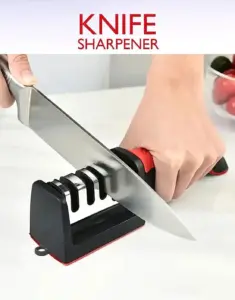
For retailers, the benefit is that knife sharpeners can be demonstrated visually. A short product video can show the sharpener’s size, grip, slot system, base, and recommended movement. A carefully performed before-and-after demonstration using an appropriate knife can help customers understand the product without relying only on packaging claims.
Knife sharpeners also work well as add-on products. A customer buying kitchen knives, chopping boards, peelers, scissors, or cooking tools may also consider a sharpener when the price and purpose are explained clearly.
Why Consider China-Imported Knife Sharpeners?
China is a major manufacturing source for affordable kitchen tools, home accessories, small appliances, and retail utility products. Buyers searching for knife sharpener in Pakistan can find knife sharpeners in many designs, materials, colours, sizes, and price categories from Chinese manufacturers.
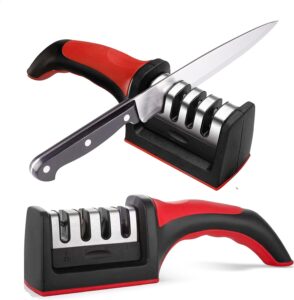
A basic handheld sharpener may contain one sharpening slot and a simple grip. More advanced models may offer separate stages for coarse sharpening, edge refinement, and polishing. Other options include suction-base sharpeners, ceramic rods, whetstones, diamond-coated systems, and electric sharpening machines, giving retailers a wide range of products to meet different customer needs.
This variety allows resellers to build inventory for different customer budgets. A general store may stock an economical pull-through model, while a kitchenware shop may offer both basic and premium multi-stage sharpeners. Hardware retailers and restaurant-supply businesses may also consider larger or more durable products for frequent use.
The words “China imported” should not be treated as a complete quality rating. Two sharpeners with similar outer bodies may use different abrasive materials, slot angles, plastics, springs, and internal components. Retailers should evaluate the exact model, test a sample, and confirm supplier terms rather than relying only on product photographs.
How Alahdeen Helps Resellers Find Wholesale Suppliers
Finding knife-sharpener suppliers through random social media posts can become time-consuming. One seller may advertise a three-stage model without explaining the abrasive material, while another may quote a carton rate without mentioning delivery charges or available colours.
Alahdeen provides a Pakistan-focused B2B marketplace where retailers, resellers, and other business buyers can discover wholesale products and communicate directly with suppliers. Alahdeen describes its platform as a place where businesses can compare products from wholesalers and manufacturers operating in different Pakistani cities.
Through Alahdeen, buyers can ask suppliers about the knife-sharpener type, material, number of stages, compatible knives, carton quantity, minimum order requirement, dispatch city, packaging, and damaged-product replacement policy.
The platform can make supplier discovery more organised, but buyers should still conduct their own verification. Product listings should be followed by actual stock pictures, samples, written specifications, invoices, and agreed replacement conditions.
For more wholesale sourcing advice, retailers can read Alahdeen’s guide on How To Buy Wholesale Products For Resale. The guide highlights supplier selection, demand research, quotation comparison, and margin calculation as important parts of wholesale purchasing.
Types of Knife Sharpeners Retailers Can Stock
Different knife sharpeners require different levels of skill and suit different types of customers. Retailers should understand what each model is designed to do before adding it to their inventory.
Single-Stage Pull-Through Sharpeners
Single-stage sharpeners are usually compact and easy to understand. The user places the blade into the slot and pulls it through according to the manufacturer’s instructions. These models may suit customers who want a simple and affordable kitchen tool without multiple settings. They can also be easy to display in supermarkets, general stores, and online listings.
Before ordering, buyers should inspect the slot alignment, handle strength, base stability, and abrasive material. A very aggressive sharpener may remove more blade material than necessary, while a weak or poorly aligned system may produce uneven results.
Two-Stage and Three-Stage Sharpeners
Multi-stage sharpeners usually separate the sharpening process into different slots. One stage may be designed for coarser sharpening, while another refines or polishes the edge. These products can appear more valuable to customers because they offer several functions in one compact tool. They may suit home cooks who want more control than a single-stage sharpener provides.
Retailers should confirm what each stage actually contains. Some low-cost products advertise three stages even though the differences between them are unclear. The packaging and instructions should explain which slot is used first and whether every stage is suitable for routine use.
Suction-Base Knife Sharpeners
Suction-base sharpeners attach temporarily to a smooth surface, allowing the user to pull the knife through the sharpening slot with one hand while keeping the other hand away from the blade. Their small size can make them attractive for compact kitchens and online resale. However, the suction mechanism must hold firmly.
Retailers should test the product on a clean, smooth countertop. A weak suction base that releases during use can create a serious safety concern. The product should also include clear instructions explaining which surfaces are suitable.
Whetstones
Whetstones provide more control over the sharpening angle and are commonly available in different grit levels. Some products combine a coarse side with a finer side. They may appeal to experienced home cooks, chefs, knife enthusiasts, and customers who prefer traditional sharpening methods. However, they usually require more skill than pull-through models.
The stone should have a flat, even surface without cracks or damaged corners. A non-slip base or stone holder can add value and improve stability. Retailers should avoid describing whetstones as beginner-friendly unless the product includes clear instructions and the customer understands that proper technique is required.
Sharpening Rods
Sharpening rods may be made from steel, ceramic, or diamond-coated material. Some rods are mainly intended for honing and realigning an edge rather than removing enough material to repair a very dull blade. This difference should be explained clearly. Customers sometimes purchase a honing rod expecting it to restore a heavily damaged knife, then assume the product does not work.
Sharpening rods should have a secure handle and a protective guard between the user’s hand and the rod. The surface should also be even and free from visible damage. Since these products are commonly used alongside everyday kitchen essentials, retailers can also expand their inventory by sourcing complementary items from the Dinner Sets, Plates & Glasses category, helping customers find a wider range of dining and kitchen products in one place.
Electric Knife Sharpeners
Electric sharpeners use motor-driven abrasive wheels or belts to sharpen a blade through guided slots. They may offer multiple stages and can provide a more automated experience.
These models may suit kitchen-appliance stores, restaurant suppliers, and customers willing to pay more for convenience. However, they carry greater wholesale risk because motors, wiring, switches, and adapters may fail.
Retailers should verify voltage compatibility, motor noise, slot alignment, electrical safety, warranty, and replacement support before stocking electric models.
Knife-Sharpener Comparison for Wholesale Buyers
| Sharpener Type | Common Features | Best Suited For | Wholesale Buying Considerations |
| Single-stage pull-through | One sharpening slot, compact body and basic grip | Budget buyers and general households | Check slot alignment, abrasive quality and handle strength |
| Two-stage sharpener | Coarse and fine sharpening stages | Regular home cooks and kitchenware customers | Confirm that both stages provide clear and useful functions |
| Three-stage sharpener | Sharpening, refining and polishing slots | Customers seeking a complete manual system | Inspect stage materials, instructions and base stability |
| Suction-base sharpener | Compact body with countertop suction grip | Small kitchens and customers wanting one-hand stability | Test suction strength on suitable smooth surfaces |
| Whetstone | Coarse and fine grit surfaces with manual angle control | Chefs, experienced cooks and knife enthusiasts | Check stone flatness, grit information and non-slip base |
| Sharpening rod | Steel, ceramic or diamond surface with handle guard | Customers maintaining an existing knife edge | Clarify the difference between honing and full sharpening |
Check Knife Compatibility Before Buying
Not every sharpener is suitable for every knife.
Some pull-through sharpeners are designed mainly for standard double-bevel kitchen knives. They may not be appropriate for single-bevel Japanese knives, serrated blades, ceramic knives, scissors, or extremely thin blades.
Michigan State University Extension notes that serrated knives often require specialised sharpening, while ceramic knives need sharpeners suitable for ceramic material. Retailers should ask suppliers for a clear compatibility list. The product description should state whether the sharpener is suitable for steel kitchen knives, Asian-style blades, serrated knives, ceramic knives, or scissors. Avoid advertising a model as universal unless the supplier or manufacturer provides credible information supporting that claim.
Because knife sharpeners are an essential part of everyday food preparation, retailers can also explore the Kitchen Utensils category to source complementary products such as cutting boards, peelers, graters, measuring tools, and other practical kitchen accessories that pair well with sharpening tools.
Inspect the Sharpening Material
The internal sharpening material affects how the product interacts with the blade. Common materials include tungsten carbide, ceramic, diamond-coated surfaces, abrasive stone, and hardened steel. Each material may serve a different stage or purpose.
Carbide stages can remove material quickly, making them potentially useful for dull blades, but aggressive use may shorten the knife’s lifespan. Ceramic stages are often used for lighter refining or polishing. Diamond abrasives may work with harder blade materials, although product quality varies.
Retailers do not need to turn product listings into technical manuals, but they should know what is inside each slot. Clear product information helps customers select a suitable sharpener and reduces misuse.
Test the Handle and Grip
The user’s hand should remain stable and away from the knife’s cutting edge during sharpening. A good handle should provide enough space for a secure grip. Rubberised or textured sections can reduce slipping, particularly when the user’s hands are slightly damp.
Inspect whether the handle bends, rotates, or feels loose. Thin plastic around the grip may crack after repeated use. Left-handed users should also be considered. Some sharpeners are designed only for a particular hand position, while others can be used comfortably from either side.
For online listings, show the sharpener in a person’s hand so customers can understand its real size.
Check the Base and Stability
A knife sharpener should remain stable during use. Manual models may use rubber feet, a wide base, or a suction mechanism. The base should sit flat and should not slide across the counter while the knife is being pulled through.
Test the sample on several suitable kitchen surfaces. A sharpener that moves under light pressure can become difficult and unsafe to use. Retailers should not demonstrate the product on wet, uneven, or unstable surfaces. Customers should be instructed to place it on a dry, secure countertop and follow the supplied directions.
Stay informed with the Alahdeen Blog: https://alahdeen.com/blogs/blogs-list
Understand Sharpening Versus Honing
Retailers can improve customer trust by explaining that sharpening and honing are related but different. Sharpening removes a small amount of blade material to recreate or improve the cutting edge. Honing mainly realigns an edge that has bent slightly during use.
A honing rod may help maintain a knife between full sharpening sessions, but it may not restore a severely dull or damaged edge. Similarly, using an aggressive sharpening slot too frequently may remove unnecessary material. This distinction is particularly important when selling rods, whetstones, and multi-stage systems. Clear guidance reduces unrealistic expectations and helps customers use the product correctly.
Request a Sample Before Buying in Bulk
A sample is essential because photographs cannot show sharpening consistency, grip comfort, base stability, or construction strength. Test the sharpener only with a suitable low-value knife and follow the supplied instructions. Inspect whether the blade passes through smoothly and whether the product creates an even result.
Check the sharpener after several uses. Internal components should not become loose, crack, or move out of alignment. For whetstones, inspect whether the surface wears evenly. For suction models, test the base repeatedly. For electric models, run the motor through each stage and listen for unusual sounds.
The supplier should confirm that the final bulk stock will match the tested sample in material, colour, packaging, and internal sharpening system.
Review Packaging and Instructions
Knife sharpeners are tools involving sharp blades, so clear instructions matter. Packaging should explain how to hold the product, which slot to use, how many passes may be appropriate, and which knife types should not be sharpened.
Retailers should avoid products with no instructions, unclear diagrams, or packaging that makes unsupported universal claims. The retail box should also protect the sharpener during transportation. Broken plastic, cracked stones, loose ceramic inserts, or bent rods can make the product unsuitable for sale.
Online sellers may need to add an outer courier box or protective wrapping, particularly for whetstones and electric sharpeners.
Confirm Ready Stock and Minimum Order Quantity
Ask whether the China-imported knife sharpeners are already available in Pakistan or will be imported after the order is confirmed. Ready stock can normally be dispatched faster and may allow smaller trial quantities. Buyers can also request actual warehouse videos showing the cartons, colours, models, and available quantities.
Future imports may involve currency changes, freight charges, customs processing, longer lead times, and larger minimum quantities. New resellers should start with a manageable order. Purchasing several different models in small quantities may provide better market insight than buying a full carton of one design.
Once customer demand becomes clear, the retailer can reorder the strongest-performing model and negotiate a better rate.
Compare Wholesale Prices Correctly
The cheapest knife sharpener may not provide the best resale value. A low-cost model may use weak plastic, an unstable base, poor internal alignment, or abrasive inserts that wear quickly. A slightly more expensive sharpener may offer better grip, clearer instructions, stronger packaging, and fewer customer complaints.
Ask each supplier for the exact model, sharpening material, number of stages, carton quantity, unit price, delivery charges, and damaged-item policy. Alahdeen allows business buyers to compare supplier options and request quotations rather than depending on a single source.
Calculate the complete cost after adding supplier delivery, packaging, advertising, marketplace fees, customer shipping support, and possible returns.
Who Can Stock China-Imported Knife Sharpeners?
Knife sharpeners can fit into several retail categories. Kitchenware shops can display them alongside knives, cutting boards, peelers, scissors, and cooking utensils. Supermarkets and general stores may offer affordable pull-through models in their kitchen-accessory sections.
Hardware retailers may stock whetstones, rods, and more durable sharpening systems. Restaurant-supply businesses can offer selected products to chefs, caterers, hotels, food stalls, and commercial kitchens.
Online sellers can demonstrate the product through careful, controlled videos, while home-based resellers can begin with compact sharpeners that are inexpensive to store and deliver. Gift and home-accessory businesses may also include sharpeners in kitchen starter packs, cooking gift sets, or household utility bundles.
How to Market Knife Sharpeners Organically
The best marketing content shows the real product and explains its purpose without exaggerated promises. A short video can show the handle, base, sharpening slots, materials, and size. A safe demonstration may use a suitable knife and follow the manufacturer’s instructions carefully.
Retailers can create educational content explaining why dull knives need more pressure, how honing differs from sharpening, and why not every sharpener suits every blade. Avoid claims such as “makes every knife brand new,” “works with all blades,” or “cannot damage knives.” Product results depend on the blade, sharpening material, technique, and condition of the knife.
Honest product education can reduce returns and position the retailer as a reliable source of kitchen tools.
Important Safety Guidance for Customers
Knife sharpeners should always be used on a dry, stable surface and according to the supplied instructions. The blade should generally move away from the user’s body, and fingers should remain away from the cutting edge. Customers should avoid rushing or using excessive force.
A newly sharpened knife should be handled carefully because its edge may be much sharper than the user expects. It should be washed and dried according to the knife manufacturer’s instructions before food preparation. Children should not use knife sharpeners without appropriate adult supervision. Damaged sharpeners, loose stones, cracked guards, or unstable bases should not be used.
Customers should seek professional sharpening for valuable, specialised, heavily damaged, or unusual blades when they are unsure whether a household sharpener is suitable.
Common Wholesale Buying Mistakes
One common mistake is selecting a sharpener only because it has more slots. Several poorly designed stages may offer less value than one or two dependable sharpening surfaces. Another mistake is describing every product as suitable for all knives. Serrated, ceramic, single-bevel, and specialty blades may require different systems.
Retailers should also avoid ordering a full carton without testing the base, grip, and internal alignment. A sharpener that looks strong in pictures may feel unstable in actual use.
Ignoring instructions and packaging can also create customer problems. A product involving knife blades should include clear and responsible guidance.
Finally, do not calculate profit only from the difference between the wholesale and retail price. Delivery, packaging, returns, and damaged products must also be considered.
Build a Long-Term Relationship with a Reliable Supplier
Once a particular sharpener begins selling consistently, access to the same quality becomes important. A dependable supplier can maintain stock, inform buyers about design changes, offer mixed-model orders, and replace verified manufacturing defects under agreed terms.
Regular resellers may negotiate lower carton rates, priority access to popular products, or customised packaging after building purchase volume. Always reconfirm the model and internal materials before reordering. Imported products can change construction, colour, packaging, or sharpening inserts between batches while keeping a similar product name.
Why Source Knife Sharpeners Through Alahdeen?
Alahdeen can make the initial wholesale search more organised by helping resellers discover relevant suppliers in one Pakistan-focused B2B marketplace. Buyers can explore listings, request quotations, compare minimum quantities, and discuss delivery terms directly. The platform may also help retailers find related products such as kitchen knives, scissors, chopping boards, peelers, cutlery sets, and other household tools.
Alahdeen supports supplier discovery, but buyers should still verify the seller, inspect samples, calculate the full resale cost, and confirm all commercial terms before making a large payment.
Conclusion
China-imported knife sharpeners can be practical inventory products for kitchenware shops, supermarkets, hardware stores, restaurant suppliers, online sellers, and home-based resellers in Pakistan.
The category includes basic pull-through sharpeners, two-stage and three-stage systems, suction-base models, whetstones, sharpening rods, and electric machines. Before buying in bulk, retailers should check knife compatibility, sharpening materials, slot alignment, handle comfort, base stability, packaging, instructions, and supplier replacement terms.
A sample or small trial order can help the buyer test quality and understand local demand before investing in a full carton. Alahdeen provides a central B2B platform where resellers and shop owners can discover suppliers, request wholesale quotations, and compare China-imported knife sharpeners for their inventory.
FAQ’s
- Where can I buy China-imported knife sharpeners wholesale in Pakistan?
Resellers can find them through kitchenware importers, hardware wholesalers, household-product suppliers, and B2B marketplaces such as Alahdeen.
- Does Alahdeen import knife sharpeners directly?
Alahdeen primarily connects buyers with suppliers. The individual seller may be an importer, wholesaler, distributor, or manufacturer representative.
- Which knife sharpener is best for retail inventory?
The best choice depends on your customers. Basic pull-through models may suit general households, while whetstones and premium multi-stage sharpeners may appeal to experienced cooks.
- Can one sharpener be used for every knife?
No. Some sharpeners are unsuitable for serrated, ceramic, single-bevel, or specialty knives. Always check the manufacturer’s compatibility information.
- What is the difference between sharpening and honing?
Sharpening removes material to recreate an edge, while honing mainly realigns an existing edge. A honing rod may not restore a severely dull knife.
- What should I inspect before buying in bulk?
Check the abrasive material, slot alignment, grip, base stability, knife compatibility, packaging, instructions, minimum order quantity, and replacement policy.
- Should retailers request a sample?
Yes. A sample allows the buyer to inspect build quality, stability, ease of use, and sharpening consistency before purchasing a full carton.
- Are electric knife sharpeners suitable for wholesale resale?
They can be, but they require more careful inspection of the motor, voltage, slot alignment, electrical safety, packaging, and warranty.
- How should knife sharpeners be marketed?
Focus on practical knife maintenance, convenience, compatibility, and product features. Avoid claiming that the sharpener works perfectly with every blade.
- What should I do if sharpeners arrive damaged?
Record an unboxing video, inspect the carton promptly, and report cracks, missing parts, loose inserts, or damaged packaging according to the supplier’s agreed replacement policy.
Source China-Imported Knife Sharpeners in Bulk
Get premium China-imported knife sharpeners at competitive wholesale prices. Ideal for retailers and bulk buyers—request your free quote today.